
Cooperative perception · Container terminal
The object your vehicle cannot see: cooperative perception
An autonomous terminal tractor approaches a junction where a container stack hides a forklift. A roadside perception node sends the state of the object, not another video stream, and the vehicle slows before it can see anything itself.
Chapters
CONCEPT FILM
The scenes, vehicles and sensors, and the boxes, tracks and labels on screen, are Spikedge's own 3D animation, not detector or controller output. The film makes no measurement claims.
01What the film shows
This is not a sensor quality problem. A camera cannot detect through a container and a lidar cannot return points from behind a wall, so there is nothing in the vehicle's own data to improve. A larger neural network does not change that geometry. What the vehicle needs is not a better guess but another point of view.
The node at the corner fuses a camera and a radar, keeps what the two agree on and sends an identity, a class, a position, a heading, a speed, an uncertainty and the time of observation. A track received over a network always describes the past, so the vehicle brings it into its own frame of reference and forward to the present before asking whether two futures want the same space at the same moment.
Perception plans on Linux; control answers on a deadline; the independent safety path keeps working either way. Cooperative perception does not replace that path. It gives the machine time before it has to act. Line of sight in the scene was not drawn by hand: it was checked by ray casting in Blender.
02Transcript
The most dangerous object in autonomous perception can be the one none of your sensors can see.
Two vehicles, one junction, and a wall of containers between them.
A camera cannot detect through a container. A lidar cannot return points from behind a wall.
And a larger neural network does not change either fact.
The vehicle does not need a better guess. It needs another point of view.
From the mast the object is simply visible.
Detection becomes a track: position, heading, and how sure we are.
Camera and radar are different physics, so they fail differently. The node keeps what they agree on.
It does not send another video stream. It sends the state of the object.
But a track received over a network describes where something was, not where it is. Time has to be part of perception.
Aligned in one frame of reference, the two vehicles finally exist in the same world model.
Detection is not the decision. The question is whether two futures share the same space.
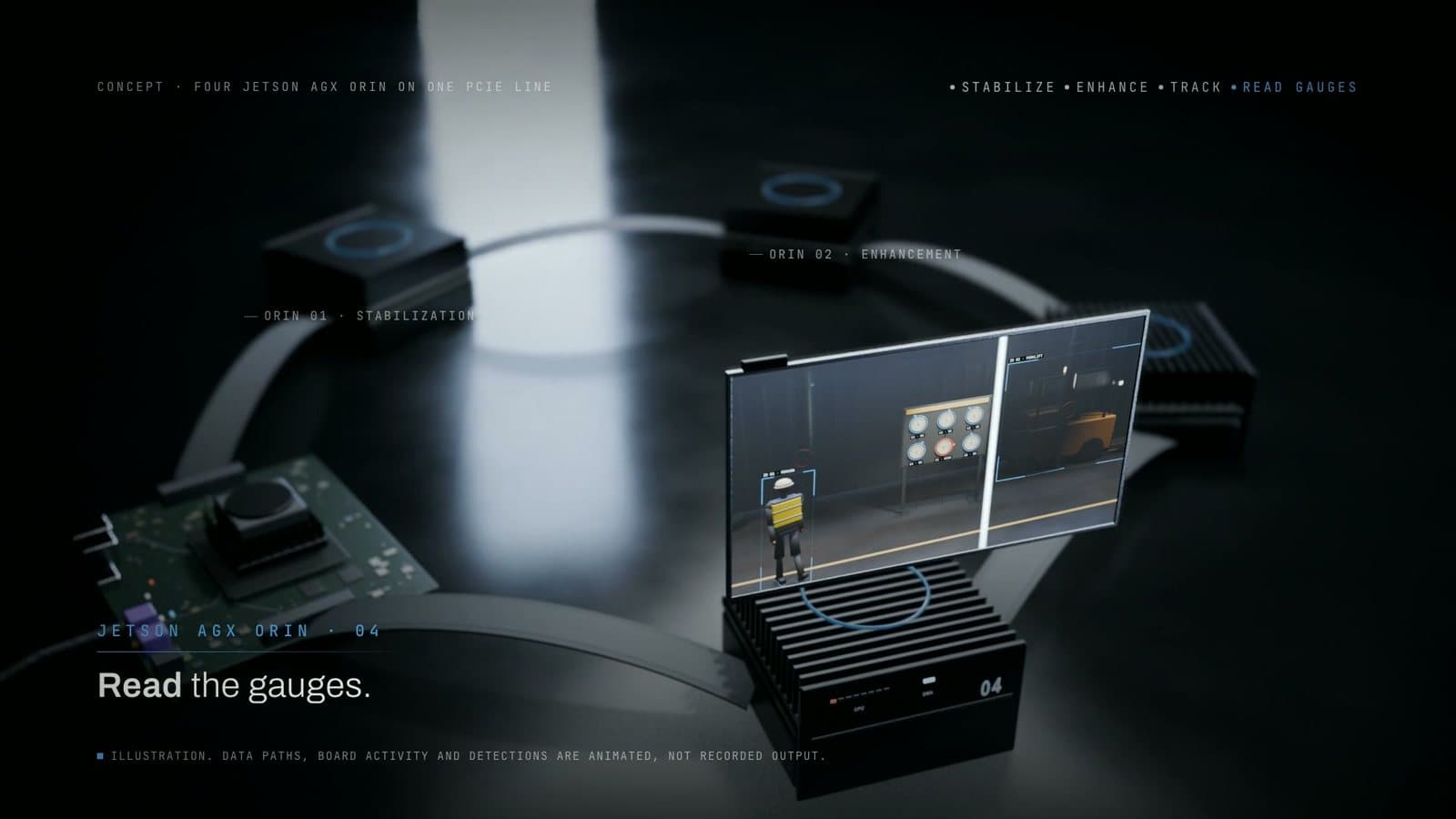
Perception plans on Linux. Control answers on a deadline.
The vehicle slows before it can see. No emergency stop. A machine that had time.
Cooperative perception does not replace the safety chain. It gives the machine time before it has to act.